Cases
impactofesgonmarketvalueandfinanceability

In the property sector, there is growing attention being paid to Environmental, Social, and Governance (ESG) criteria. Investors are showing increasing interest in sustainable investments that contribute to making the built environment more sustainable. Buildings that are energy-efficient, use renewable energy sources and have lower CO2 emissions are becoming increasingly attractive to investors. ESG factors increase the value of buildings, as they entail fewer risks and are better prepared for future regulations and market trends.
But exactly how much does ESG contribute to market value? And how can this be quantified, what role do financiers play in this, and does sustainable property also offer a price advantage? Martijn Nijland, owner of consultancy firm PPREF, which specialises in Paris Proof Real Estate Finance, and Wessel van Loon, Business Lead Commercial at Envalue, explain more in this article.
Quantifying ESG data points
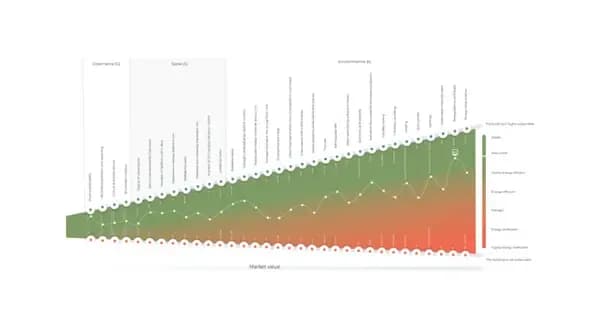
Envalue has developed a methodology to quantify ESG data points by scoring each data point and placing it in so-called ‘buckets’. The graph above shows the relationship between ESG measures and the market value of buildings. For each data point, the lower and upper limits are presented. In this way, the data point can be quantified, revealing whether it makes a positive or negative contribution to the value of the property.
The analysis shows that buildings that do not meet the highest standards for ESG data points will experience a downward effect on their market value. Conversely, meeting the highest standards will have a positive effect on market value.
By enriching property transactions with ESG scores, a more detailed analysis of their ESG performance can be carried out and they can be compared with valuation figures. Initially, this can be done qualitatively, by categorising transactions as worse, comparable or better than the valuations.
Analyses and impact on market value
By performing multiple regressions, the contribution of ESG criteria to market value and the gross initial yield (GIY) can be determined. Using these results, the share of ESG in the GIY can be translated into the market value of the appraised property. It is important to note that, in addition to ESG, other value-determining factors also have an influence, such as location, type and length of the lease, and the quality of the tenant. By combining these various elements, the impact of ESG on the market value of property can be accurately analysed and quantified, enabling investors and financiers to make better-informed decisions.
Role of financiers
Financiers are increasingly incorporating compliance with the Paris Climate Agreement into their strategies. This is partly driven by evolving legislation and regulations. The European Corporate Sustainability Reporting Directive (CSRD) will require companies to report on their impact on people and the climate from 2024 onwards. It identifies three scopes. Scope 1 covers direct CO2 emissions from sources owned and controlled by the organisation itself. Scope 2 covers indirect emissions from purchased energy, and scope 3 covers all other indirect emissions within the organisation’s supply chain.
Financial institutions initially scrutinise emissions within their own organisations (Scopes 1 and 2). However, the funds provided by a financial institution facilitate a multitude of external activities. The emissions associated with these external activities fall under Scope 3. This includes, amongst other things, the property being financed. The proportion of Scope 3 emissions in the property sector is already much higher (up to a hundred times higher) than in other activities, and this is even more pronounced for financing, with a factor of 700 often cited as an estimate.
Price advantage for sustainable property
Property financiers increasingly view sustainability and a strong ESG profile as a key condition for providing financing. A standard price advantage cannot be directly linked to this.
- In practice, a relatively limited discount is offered for sustainability, ranging from a few basis points to a few tenths of a per cent. To this end, financiers include ‘green KPIs’ that must be met.
- On Green Loans, Green Bonds, or Sustainability-linked loans, somewhat more substantial discounts can be obtained.
- With Dutch lenders, a discount of up to around 0.14% can be obtained if the conditions of the RVO’s green declaration are met.
- For sustainability measures, a slightly higher advance payment, up to around 80%, can generally be obtained.
In general, the advantage in financing costs for sustainable property arises mainly because non-sustainable property is much more expensive to finance or cannot be financed at all by traditional banks. In the latter case, this means that a debt fund, with significantly higher margins, is the next best alternative for obtaining financing.
Mapping indirect emissions from property financing
Martijn Nijland predicts that sustainability and its impact will become even more central to financiers, with their focus shifting significantly from energy labels to actual consumption. Financiers are increasingly seeking evidence of the impact that the property they finance has on the environment and society in order to comply with Scope 3 of the CSRD. Financiers want to be able to assess:
- Depreciation, value retention or appreciation
- Lettability and marketability
- Or investments required to take properties to the next level of sustainability
Payback period for the party making the investments is a point of consideration here, but is not the primary focus for financiers.
Ultimately, ESG, sustainability and climate risks are playing an increasingly significant role in financiers’ core activity: assessing credit risk. It is therefore no coincidence that banks, in particular, are in favour of DuPa 2.0. Relatively comparable ESG valuations, in which a fixed set of data points is assessed, also help to measure the performance and market position of properties in relation to the softer components and are therefore an inevitable next step.