Thought leadership
dataintegrationforhotelvaluations

“Over the past six months, I have had the opportunity to carry out my final-year research project within the dynamic world of the property sector, with a specific focus on the hotel sector. This research, conducted in collaboration with Envalue Real Estate, marks the culmination of my studies at Hanze University of Applied Sciences in Groningen,” says Gijs Tervooren. In this blog, you can read more about data integration for hotel valuations through the use of programming languages and data analysis techniques. The aim was to refine hotel valuations at Envalue.
Providing better evidence based on data
Due to the diverse nature of hotel property and the provision of highly confidential information (operating figures, lease agreements), it is complex to value hotel property. The specialist valuers who normally carry out these valuations rely heavily on their extensive market knowledge for accurate assessments, supported by public market reports and references. Both of these are difficult and scarce to find. The aim of my research was therefore to bring about a change in this regard for Envalue.
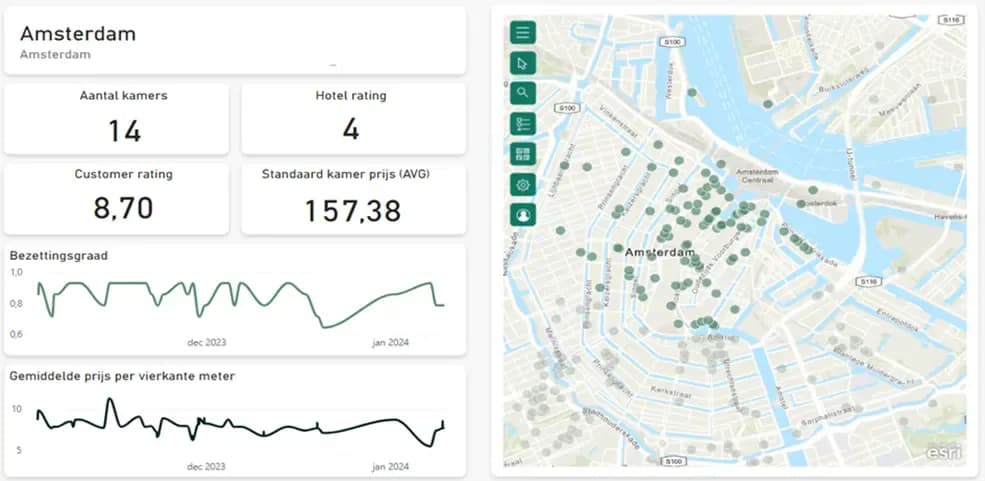
Gijs continues: “I wanted to offer valuers better ways to substantiate their assessments based on data. I achieved this by analysing multiple rental and hotel websites and using data extraction methods. The result: a dataset containing information on star ratings, facilities, consumer ratings, room rates and the number of rooms for 1,600 hotels in the Netherlands. You can see a screenshot of this dataset below.
Data collection
For example, the information on the number of rooms per hotel was obtained by using artificial intelligence to scan every hotel and booking website to extract the most recent data on the total number of rooms.
Machine learning model
Using this dataset, it was possible to train a machine learning model. This model is capable of predicting room prices based on the data from the dataset. For example, predictions based on star rating and the number of rooms. The accuracy of this model increases as the volume and diversity of the input data grow. In addition to the data from the dataset, regional characteristics have also been included to enable the prediction of regional price differences.
But what does this actually mean for the valuer?
Using the dataset and the machine-learning model, the valuer can provide a solid basis for valuations, supported by both expertise and relevant data analyses as described above. This enables a faster and more comprehensive hotel valuation underpinned by data.
AVM for hotel property
Although an AVM for hotel property is not yet within reach, this research illustrates the potential of modern technologies to significantly improve property valuation. The methods used are more widely applicable and can offer significant added value in valuations. This is particularly true as the quality and availability of public data improves day by day.